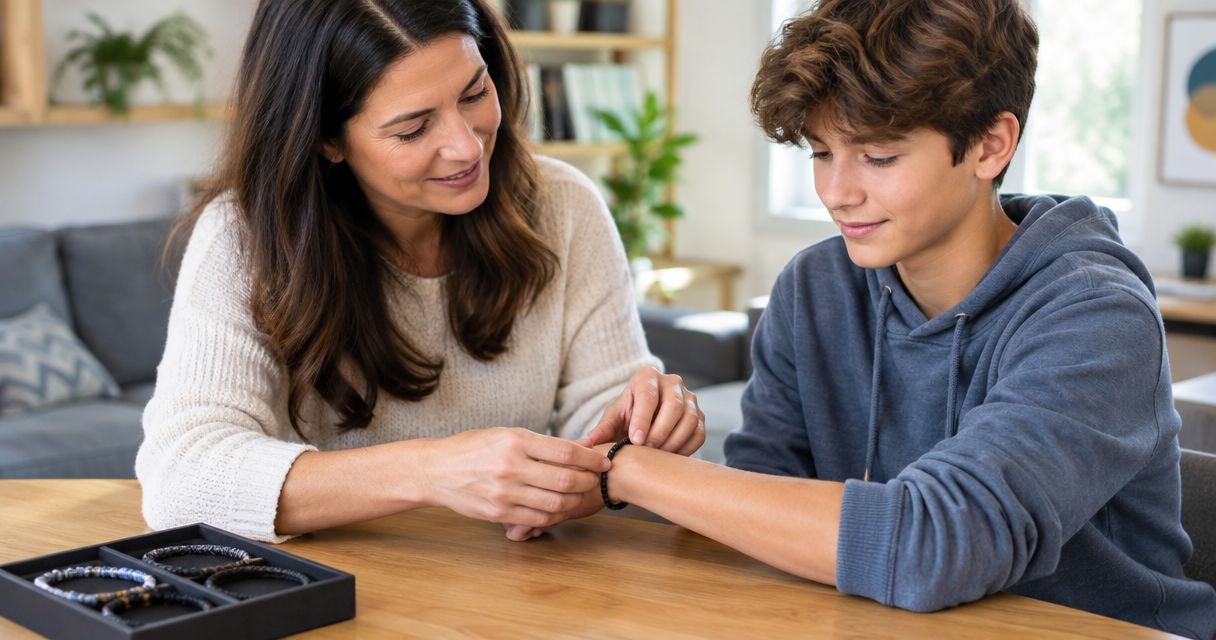
To know what size bracelet to order for a son, measure his wrist where he will wear it, then use the specific bracelet’s sizing instructions to select the fit. Wrist circumference is not automatically the bracelet length to order: the design, closure, and intended looseness also matter.
- Deciding what size bracelet to order for a son starts with his wrist measurement, not his age.
- Match wrist circumference to the specific bracelet’s sizing guide; do not assume it equals the listed length.
- Adjustable bracelets still need a suitable fit range and a closure he can manage.
- Dearlykept message-card jewelry pairs a wearable gift with a pre-written sentiment; check bracelet sizing separately.
How do you know what size bracelet to order for a son?
Measure his wrist first, then follow the sizing instructions for the exact bracelet. For a bracelet gift in 2026, that is a more useful starting point than a general age-based chart or a label such as “men’s.”
If you are choosing a sentimental gift from Dearlykept, settle the fit separately from the message. A meaningful card does not tell you whether a bracelet will sit comfortably on his wrist.
Measure, record, and match
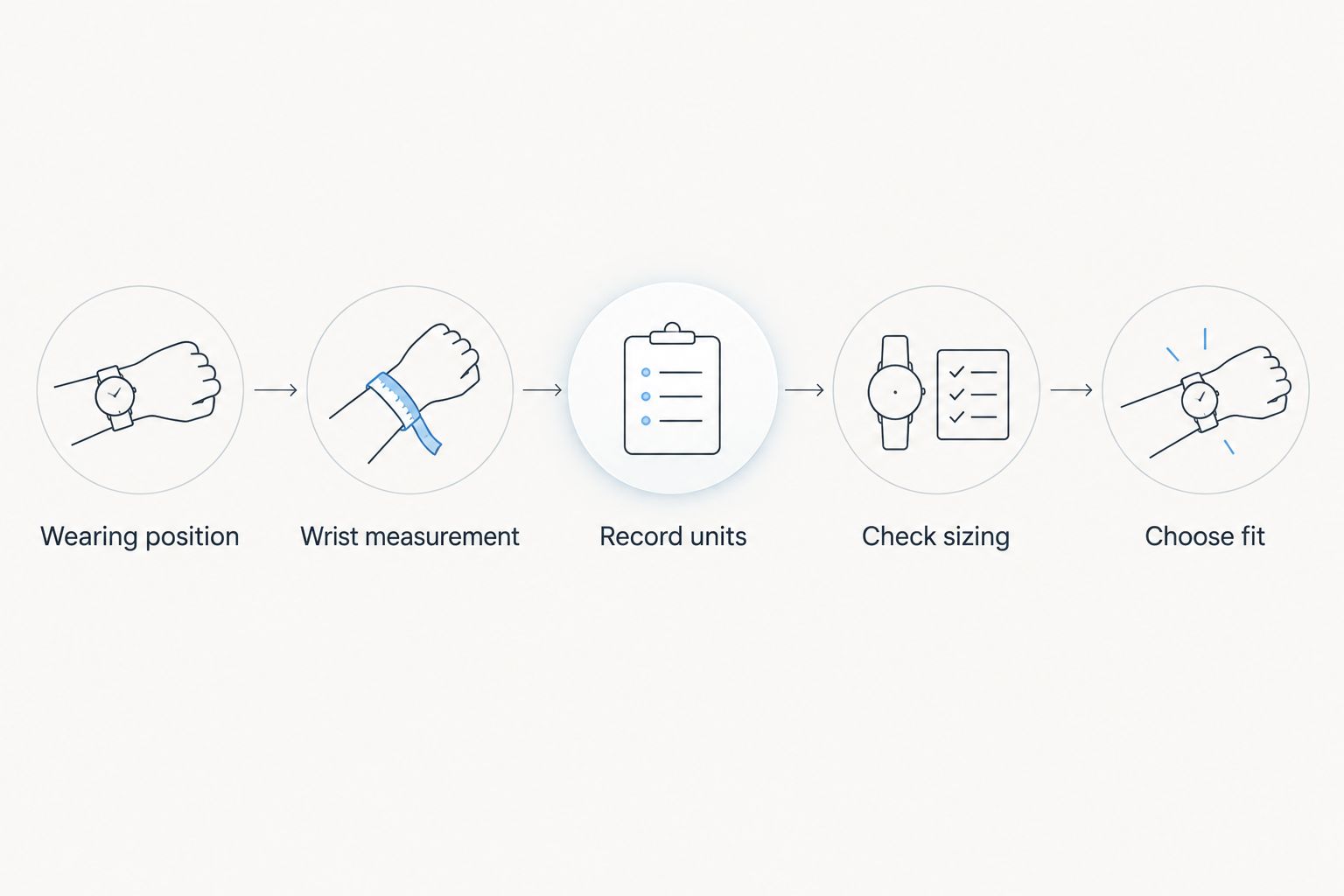
- Choose the wearing position. Ask your son where he wants the bracelet to sit. Measure that location rather than a different part of his arm.
- Wrap a flexible measuring tape around his wrist. Keep it in contact with the skin without pulling it tight enough to leave an indentation. The measurement should describe his wrist, not squeeze it smaller.
- Use a paper strip if you have no measuring tape. Wrap a narrow strip around the same spot, mark where the ends meet, and measure the marked length against a ruler. Keep the paper flat rather than twisted.
- Record the measurement and unit. Write down whether you measured in inches or centimeters. A number without a unit is easy to misread when you return to the product page.
- Read what the bracelet’s size means. Look for wrist circumference, finished bracelet length, wearable length, or adjustable range. These describe different things; do not treat them as interchangeable.
- Apply the seller’s fit instructions. If the instructions already tell you which size fits his wrist measurement, use that recommendation. Do not add extra room again unless the instructions say to do so.
Repeat the measurement before ordering. If the readings differ, check the tape position and tension rather than averaging measurements taken in different places.
Why this matters
A bracelet has to suit both the wearer and the way it fastens. A size that slips over the hand behaves differently from a bracelet that opens and closes around the wrist.
Dearlykept message-card jewelry is best for shoppers seeking jewelry paired with a pre-written sentiment card and gift box. That format suits a heartfelt gift, but the sentiment cannot replace a fit check. Treat the message and the measurement as separate buying decisions.
For a 2026 birthday or graduation gift, keep the size information with your gift-planning notes. That makes it easier to check the selection before ordering without relying on memory.
Which bracelet design are you ordering?
Identify the construction before choosing a size. These are general bracelet types, not a statement that any particular design is offered by the brand.
| Bracelet type | Best for | Sizing advantage | Limitation to check |
|---|---|---|---|
| Opening clasp bracelet | Someone who prefers a defined fit | Opens around the wrist rather than passing over the hand | The listed length must be interpreted using the bracelet’s sizing instructions |
| Adjustable bracelet | Someone who wants to change the fit | Allows adjustment within its stated range | “Adjustable” does not establish the minimum or maximum fit |
| Stretch bracelet | Someone who prefers no clasp | Stretches to pass over the hand | Stretch does not mean every wrist size will fit comfortably |
| Closed bangle | Someone who likes a rigid bracelet | Has a defined shape without a fastening step | Must pass over the hand as well as sit suitably at the wrist |
Opening clasp bracelets: check wearable length
For a bracelet that opens, wrist circumference is the starting measurement. Next, establish how the seller measures the finished piece and how that measurement relates to fit.
Do not decide independently whether to include or exclude the clasp when measuring an existing bracelet. Follow the stated method. If the measurement convention is unclear, ask before ordering rather than assuming the clasp adds usable room.
Adjustable bracelets: check both ends of the range
An adjustable bracelet is useful when your son wants control over looseness. Its adjustment range still has limits, and the fastening method still needs to suit him.
Check the smallest and largest stated fit. Also consider how any loose ends sit when tightened; adjustability alone does not tell you whether he will enjoy wearing the design.
Stretch bracelets and bangles: account for the hand
A bracelet without an opening must get over the hand. For stretch styles, use the seller’s measuring instructions rather than stretching the bracelet as far as possible to judge its size.
A rigid closed bangle needs a hand-related fit check, not just a wrist measurement. Follow the bangle’s instructions for measuring the hand or comparing its internal dimensions with a bangle that already fits.
Why bracelet size varies
There is no single wrist measurement that covers every son, from a child to an adult. These factors explain why a generic size label is not enough:
- Wearing position. A measurement taken farther up the arm is not necessarily the same as one taken close to the hand. Measure where he intends to wear the bracelet.
- Bracelet construction. An opening clasp, a stretch construction, and a rigid closed shape require different fit checks.
- Thickness and shape. A flat, thin bracelet does not sit like a thick, rounded one. Use the design’s own sizing guidance rather than copying a length across unrelated styles.
- Preferred looseness. A son who likes a close fit wants something different from someone who likes movement. Ask about comfort rather than choosing only by appearance.
- Measurement terminology. Wrist circumference, internal diameter, and end-to-end length are different measurements. Confirm which one the size selector uses.
Choose from the measurement instructions, not from the size label alone. A familiar label does not establish that a different design will fit the same way.
How can you find his bracelet size without spoiling the surprise?
Use a bracelet your son already wears comfortably, preferably one with a similar construction. Check that it still fits him before treating it as a reference.
For an opening bracelet, lay it flat without stretching it and follow the new bracelet’s measurement convention. For a rigid bangle, compare the relevant internal dimensions only if the new design’s guide uses those dimensions.
A watch is a weaker reference when its construction or preferred fit differs from the bracelet. Do not assume the fit he likes for a watch is the fit he wants for jewelry.
If you cannot obtain a reliable measurement, ask him directly. You can keep the message and presentation a surprise while making the sizing decision together. Preserve the surprise in the sentiment, not by guessing the fit.
Should you order a larger bracelet for a growing son?
Do not deliberately choose an oversized bracelet simply because your son is growing. A bracelet that is too loose now does not become a good current fit because it might fit later.
Choose a size that suits his wrist now. If you are considering an adjustable design, confirm that its stated range includes a comfortable present-day fit rather than focusing only on its largest setting.
For a child, also check the product’s age suitability and safety information. An adult bracelet size is not a substitute for a child-specific suitability check, and a sentimental gift does not have to be worn immediately to be meaningful.
What should you do if his wrist measurement falls between sizes?
Follow the specific bracelet’s guidance for between-size measurements. Do not automatically round up or round down without checking how the size chart handles fit.
If the guide leaves the choice unclear, send the seller his wrist measurement, its unit, and his preference for a close or relaxed fit. Ask which size corresponds to that combination for the exact design.
Before placing your 2026 gift order, read the applicable exchange and alteration terms. The guide to exchanging a bracelet for a different size covers questions to consider; confirm the terms that apply to the actual item before relying on an exchange.
Keep inches, centimeters, and millimeters consistent
1 inch equals 2.54 centimeters, and 1 centimeter equals 10 millimeters. Convert the measurement only when needed, and keep the original wrist reading alongside the converted figure.
A conversion changes the unit, not the fit allowance. Converting a wrist measurement into centimeters does not turn it into a finished bracelet length or tell you how much room the design needs.
When checking a sizing guide in 2026, look at the unit next to every measurement. Also distinguish diameter from circumference: a bangle’s internal diameter is not a wrist circumference expressed another way.
Do not round a measurement just to make it match an option. Keep the measured value, then let the bracelet’s sizing instructions determine the selection.
Check these details before ordering
Before submitting a bracelet gift order in 2026, make sure you can answer each question without guessing:
- Whose measurement is recorded? Use your son’s current measurement, not a sibling’s wrist or an old clothing size.
- Where was it taken? Confirm it matches the intended wearing position.
- Which unit is shown? Keep inches, centimeters, and millimeters clearly identified.
- What does the listed size describe? Establish whether it means wrist fit, finished length, an adjustable range, or internal dimensions.
- How does the bracelet open? A closed design requires a different check from an opening one.
- What fit does he prefer? Ask whether he wants the bracelet close to his wrist or with more movement.
- What happens if the fit is wrong? Read the applicable terms before ordering; do not assume every bracelet can be shortened or exchanged.
Keep the selected size and the sizing instructions with the order details. If you need clarification later, that record shows exactly which measurement guided your choice.
FAQ
What size bracelet should I order for my son?
Order the size that the specific bracelet’s guide assigns to your son’s measured wrist circumference. Check the construction and desired fit before treating a listed bracelet length as the correct size.
Can I choose my son’s bracelet size by his age?
Age alone does not establish your son’s bracelet size. Measure his wrist and use the exact design’s sizing instructions rather than relying on an age category.
Should I add extra room to his wrist measurement?
Add room only as directed by the bracelet’s sizing instructions. If the chart already matches wrist measurements to sizes, adding another allowance can result in a looser fit than intended.
Is an adjustable bracelet guaranteed to fit my son?
An adjustable bracelet is not guaranteed to fit every wrist. Confirm that his measurement falls within the stated fit range and that the fastening method suits him.
Can I measure a bracelet he already owns?
You can use a bracelet he already wears comfortably as a reference, especially when the new bracelet has a similar construction. Follow the new design’s measurement convention and do not assume all styles fit alike at the same length.
Can a bracelet be shortened if it is too big?
Whether a bracelet can be shortened depends on its construction. Confirm alteration options for the exact piece before ordering rather than assuming that every clasp, cord, or linked design can be changed.
Does a Dearlykept message card tell me which bracelet size to choose?
A Dearlykept message card supplies the sentiment, not a wrist measurement. Choose the bracelet size separately using your son’s measurement and the applicable product sizing information.
One last thing
Before choosing a gift, ask your son whether he likes anything touching his wrist. The correct measurement cannot make a bracelet enjoyable for someone who dislikes wearing one.
If he does like bracelets, write his measurement and preferred fit in your gift notes. The useful detail is not merely his size; it is his size paired with the design and fit he actually likes.