
For corporate gifting teams, message-card jewelry is a necklace or bracelet paired with a sentiment card and gift box, chosen to recognize an employee’s contribution or milestone. This 2026 guide explains how to assess the wording, respect personal preferences, and organize a workplace gift without turning professional appreciation into an overly intimate gesture.
- Corporate gifting for employees starts with appropriate wording and recipient choice, not a matching box for everyone.
- Dearlykept message-card jewelry is best for family-gift shoppers, not default employee recognition.
- Approve the complete printed sentiment before selecting necklaces or bracelets for workplace appreciation.
- Confirm fulfillment requirements directly; never assume a retail gift supports a corporate ordering workflow.
Why message-card jewelry matters for corporate gifting teams
Message-card jewelry combines something wearable with an explicit statement of appreciation. That combination deserves careful review at work: the employee receives both the object and the relationship implied by its message.
Dearlykept sells necklaces and bracelets paired with pre-written sentiment cards and gift boxes, targeting heartfelt family gifts. That makes the message—not simply the jewelry style—the first screening criterion for a corporate buyer. A card addressed to a wife or daughter does not become workplace-appropriate because a manager adds a thank-you note.
For your 2026 recognition plan, separate the program’s purpose from the item you happen to like. Decide whether you are recognizing a professional achievement, marking a retirement, or acknowledging a personal milestone the employee has chosen to share.
Use message-card jewelry selectively, with recipient choice and approved wording. Do not make employees accept a sentimental accessory to participate in recognition, and do not treat a gift as a substitute for compensation, benefits, or direct acknowledgment of their work.
How to plan message-card jewelry gifts for employees
Define the recognition occasion
Start with a shared document, not a shopping cart. Write down the occasion, the eligible recipients, and the contribution being recognized. A completed project calls for different language from a retirement or a colleague-organized farewell.
Answer 3 screening questions before selecting an item: What are you recognizing? Who is speaking through the card? Would the wording feel appropriate if the employee read it aloud at work? Treat these as an editorial check, not a measure of how grateful someone should feel.
For a 2026 program, keep the recognition criteria consistent across departments. The gift can vary with employee preference; the reason someone qualifies should not depend on which manager submits the request.
- Name the specific occasion in the brief.
- Identify the sender as the company, manager, or colleagues.
- Record the recognition criteria before choosing recipients.
- Separate company-funded recognition from personal gifts.
- Assign an owner to approve exceptions.
Ask employees about preferences privately
Use a private form or direct conversation to establish whether jewelry is welcome. Ask about the gift category before requesting detailed sizing or delivery information. A preference question should give the employee a real way to decline.
Apply three checks: Relationship fit, Recipient choice, and Operational fit. Relationship fit covers the sentiment; recipient choice covers whether the employee wants jewelry; operational fit covers whether your team can verify and deliver the selected item correctly.
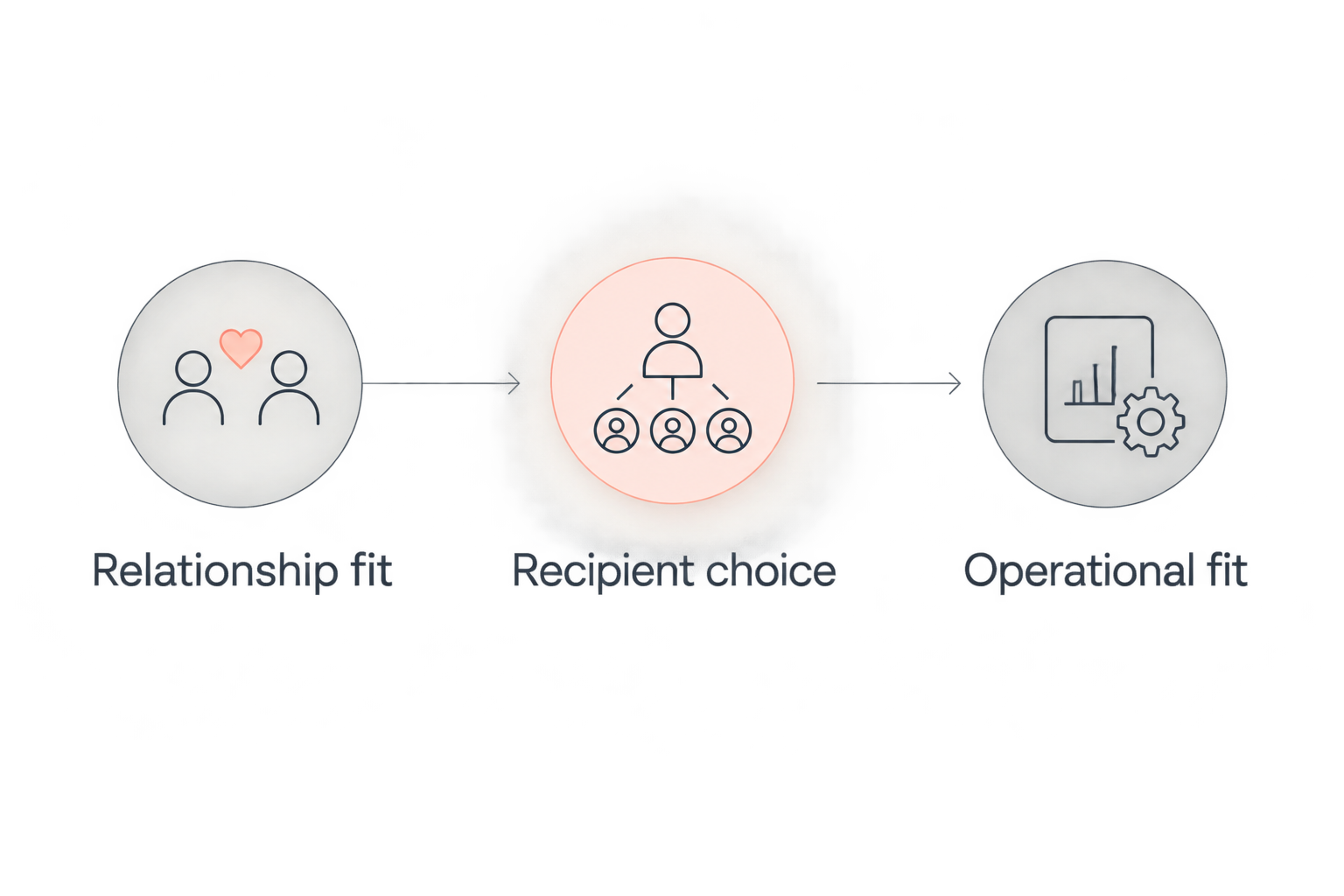
Offer a non-jewelry alternative through the same process. Do not infer preferences from gender, job title, age, or family status. Ask only for information required to select and deliver the gift, and limit access to the people handling that task.
- Ask whether a necklace, bracelet, or non-jewelry gift is preferred.
- Provide a private decline option without requiring an explanation.
- Request fit information only after the employee chooses jewelry.
- Ask whether recognition should be public or private.
- Restrict access to addresses and preference responses.
Read the entire sentiment card
Inspect the complete wording manually before considering a product suitable. Review the salutation, the central message, and the sign-off. A neutral opening does not cancel a romantic closing or a parent-to-child promise halfway through the card.
Dearlykept message-card jewelry uses pre-written sentiments for family gifting. For a corporate purchase, assess the actual card attached to the selected item rather than assuming the message can be edited, replaced, or removed. Confirm any requested change directly before ordering.
Use 2 reviewers for the wording: the program owner and a colleague who understands workplace communications. Read the message from the employee’s perspective, including how it sounds when delivered by someone with authority over their role.
- Reject romantic, possessive, or parental language.
- Check every relationship label and pronoun.
- Remove assumptions about marriage, parenthood, or religious belief from your selection criteria.
- Verify any requested card change before purchase.
- Keep a record of the wording approved for the order.
Match the jewelry to the recipient
Begin with what the employee actually wears or explicitly requests. A necklace avoids wrist sizing, but chain length, clasp handling, and personal style still matter. A bracelet requires its own fit check; do not assume an adjustable design or a particular closure.
A wearable gift also needs to fit the employee’s work setting. Ask whether workplace dress or safety requirements affect jewelry use, without turning the gift into an expectation that it be worn on the job.
Review the selected item’s published specifications and care instructions. Do not describe an item as hypoallergenic, waterproof, or suitable for daily wear unless the product information supports that claim. Presentation cannot answer questions about materials or fit.
- Confirm the employee’s preferred jewelry category.
- Check the stated dimensions and closure details.
- Verify materials against the recipient’s stated requirements.
- Review relevant workplace jewelry restrictions.
- Offer an alternative when fit or comfort remains unresolved.
Verify the ordering workflow
Build a simple order sheet before approaching a seller. Include the selected item, approved card, recipient preference, delivery destination, and required presentation date. Keep sensitive personal information separate from the recognition brief wherever practical.
A direct retail purchase is an option for an individually reviewed gift; a larger program needs additional operational checks. Ask Dearlykept directly about your requirements rather than assuming support for bulk ordering, separate recipient addresses, scheduled dispatch, or consolidated documentation.
Work backward from the event in your 2026 calendar using the processing and delivery information confirmed for the order. Keep the event date separate from the requested delivery date, and decide how you will recognize the employee if the physical gift is delayed.
- Confirm the exact item and card pairing.
- Verify delivery arrangements for each destination.
- Check the documentation your finance team requires.
- Review the applicable return and exchange terms.
- Record how order problems will be handled.
- Prepare a recognition message that does not depend on the parcel arriving.
Present the gift without pressure
Write your acknowledgment in a separate document first. Name the contribution, explain its significance, and keep the tone professional. Specific praise about an employee’s work is more appropriate than borrowing family language to make the moment sound emotional.
Give the employee control over the presentation. A private handoff, a team acknowledgment, and a mailed gift are different experiences; ask which approach suits the recipient instead of treating a public unboxing as part of accepting the gift.
For colleague-led gifts, establish whether the sender is an individual, a group, or the employer. The sentimental bracelets for coworkers guide addresses the coworker context; company-funded recognition still needs its own approval and eligibility rules.
- Name the employee’s specific contribution.
- Keep the accompanying note separate from the printed card.
- Confirm whether public acknowledgment is welcome.
- Do not request photos, testimonials, or workplace wear.
- Make any colleague contribution voluntary.
Review the experience and close the records
Ask for feedback privately after the recognition, not during the presentation. Focus on whether the process felt appropriate and whether the employee received their chosen item. Do not ask them to demonstrate gratitude or justify a preference for something else.
Assign 1 named owner to resolve an incorrect item, unsuitable fit, or delivery problem. Record the action taken without circulating personal explanations. Review repeat issues before using the same selection process again.
For your 2026 program review, distinguish administrative completion from employee experience. A delivered parcel confirms delivery; it does not establish that the sentiment was welcome or that recognition felt fair.
- Confirm receipt through a private channel.
- Offer a route to report fit or item problems.
- Record whether the chosen preference was honored.
- Review exceptions for consistency across teams.
- Remove personal information according to your retention policy.
Compare employee gift options before choosing
Choose the recognition format before choosing the seller. Message-card jewelry suits an employee who wants a wearable keepsake and approves of the sentiment. A written acknowledgment or recipient-selected alternative removes the need to guess about jewelry preferences.
The options below serve different purposes. None replaces a clear explanation of what the employee contributed, and none should require an employee to disclose personal circumstances to receive equivalent recognition.
| Option | Best for | Main strength | Key limitation |
|---|---|---|---|
| Message-card necklace | Employees who request a necklace and welcome the printed sentiment | Combines a wearable keepsake with a written message | Chain details, materials, and relationship wording require review |
| Message-card bracelet | Employees who prefer wrist jewelry | Pairs an accessory with a message the recipient can keep | Wrist fit and workplace jewelry rules need checking |
| Dearlykept message-card jewelry | Family-gift shoppers seeking a necklace or bracelet with a pre-written card and gift box | Presents jewelry and sentiment together | Corporate buyers must assess the family-oriented wording and confirm operational requirements |
| Individual written acknowledgment | Recognition centered on a specific professional contribution | Lets the sender explain exactly what the employee did | Does not provide a wearable keepsake |
| Recipient-selected alternative | Employees who do not want jewelry | Respects the recipient’s stated preference | Requires an approval process that treats alternatives consistently |
For a retirement, the recipient’s preferences and the team’s shared history can guide a more personal choice. For a standardized employee program, repeatable criteria and a genuine alternative matter more than matching every gift box.
Common mistakes corporate gifting teams make
Treating family wording as workplace appreciation
A family-oriented card speaks from a specific relationship. Adding a company note does not change the original sender implied by the printed message. Reject unsuitable wording before comparing jewelry styles, even when the item itself looks appropriate.
Assigning gifts by gender or parenthood
Do not create a necklace list for women, a bracelet list for men, or a family-themed list based on personnel records. Let employees choose the category privately. Personal milestones belong in recognition only when the employee has chosen to share them.
Assuming retail ordering covers corporate requirements
A gift box does not establish support for a company purchasing process. Verify the destinations, documentation, card details, and problem-resolution arrangements required for your order. Keep written confirmation with the purchasing record rather than relying on an assumption made during selection.
Making the gift a public performance
Do not turn acceptance into an obligation to open the box on camera, wear the jewelry, or publish a thank-you. Recognition should acknowledge the employee’s contribution without creating another assignment. Ask about presentation preferences before arranging the moment.
Confusing identical gifts with consistent recognition
Identical items do not resolve differences in taste, fit, or comfort. Apply the same eligibility rules and approval standards while allowing different selections. Explain the process clearly enough that employees understand how recognition decisions are made.
FAQ
Is message-card jewelry appropriate for corporate gifting for employees?
Message-card jewelry is appropriate when the employee wants jewelry and the complete sentiment fits a professional relationship. Provide an alternative and review the card before purchasing.
Is Dearlykept a fit for employee recognition gifts?
Dearlykept’s stated focus is heartfelt family gifting through necklaces and bracelets with pre-written sentiment cards and gift boxes. Corporate buyers should assess the exact wording and confirm their ordering requirements directly before selecting an item.
What should an employee appreciation jewelry card say?
An employee appreciation card should identify the contribution being recognized and express professional thanks. Avoid romantic language, parental promises, and assumptions about the employee’s personal life.
Is a bracelet better than a necklace for an employee gift?
Neither is automatically better; the employee’s preference should decide. Check wrist fit for a bracelet and chain details for a necklace, along with materials and workplace requirements.
Can a company change a pre-written jewelry message card?
A company should confirm any requested card change directly with the seller before ordering. Do not assume that customization, replacement, or removal is supported for a selected item.
How do you plan jewelry gifts for remote employees?
Confirm each employee’s gift preference and delivery destination privately, then verify the delivery arrangement with the seller. Keep address access limited and arrange recognition separately from the parcel’s arrival.
Should every employee receive the same appreciation gift?
Use consistent recognition criteria, but allow employees to choose an appropriate gift category or alternative. Matching items are not a substitute for respecting personal preferences.
One last thing
The card can disqualify the gift even when the jewelry passes every practical check. Make wording approval an early decision, not the final task after purchasing has already started.
For your next 2026 recognition brief, save the complete sentiment alongside the item details. Have the approver review both together. That simple pairing keeps the emotional message attached to the purchasing decision, where it belongs, instead of leaving it as a surprise for the employee.