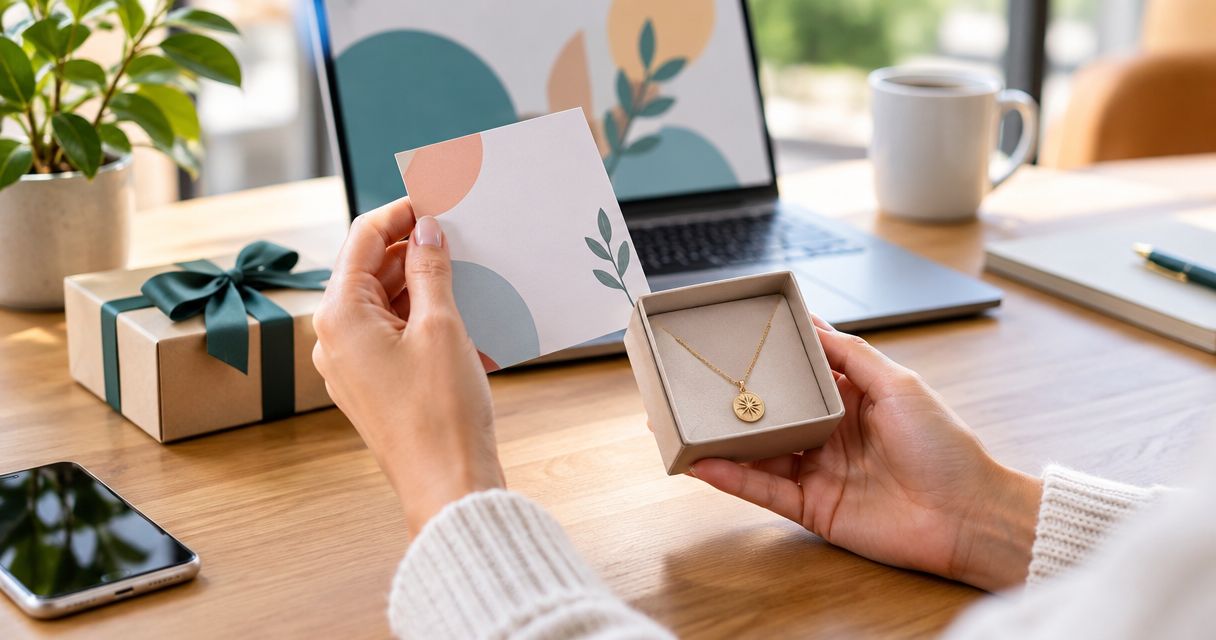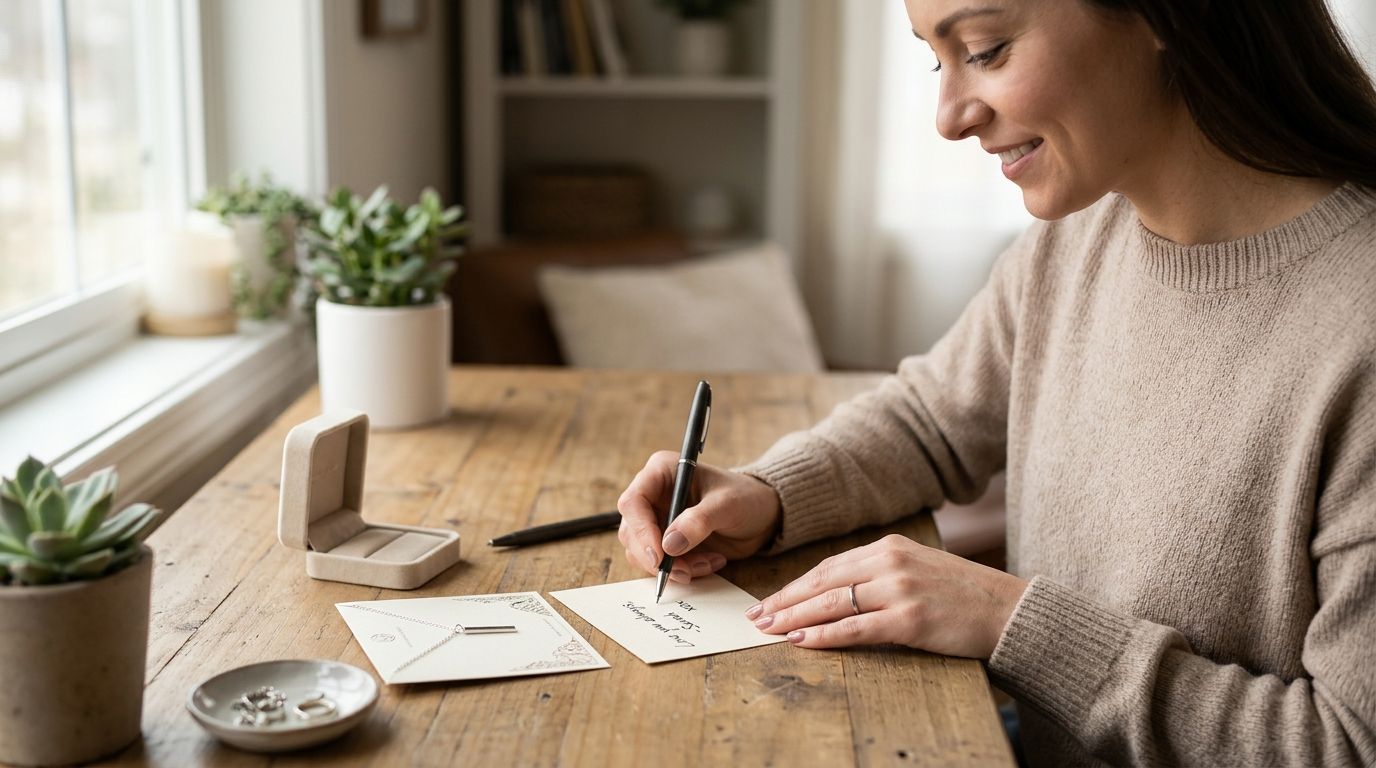
Instead of trying to rewrite a pre-written sentiment card, add your own note to message card jewelry on a separate enclosure, then place it with the gift without covering the original message. This guide shows you how to draft, check, and pack that note—or send it separately when you cannot handle the necklace before gifting it.
- To add personal note to message card jewelry, use a separate enclosure rather than writing over the sentiment card.
- Dearlykept suits shoppers who want message-card jewelry with a pre-written sentiment and their own accompanying words.
- Write one specific memory, explain why it matters, and sign the note in your usual voice.
- For gifts sent directly, confirm seller instructions before assuming a personal note will be included.
Why this matters
A pre-written card gives you the starting sentiment. Your note supplies the detail that belongs to your relationship: what your daughter worked through, what your wife does that you notice, or the small kindness your mom never mentions.
Dearlykept message-card jewelry is best for shoppers who want a pre-written sentiment with room for their own accompanying words. Dearlykept sells necklaces and bracelets paired with a sentiment card and gift box; the separate-note method does not depend on changing that printed card.
For a 2026 gift, keep the jobs distinct: let the original card express the broad feeling and let your enclosure explain why you chose it. Repeating the same sentiment adds length, not personal detail.
Before you start
- Gather the materials. Have your draft, a pen or printer, and a separate piece of paper or card. If you are assembling the gift yourself, have the gift box beside you so you can check the fit.
- Confirm the delivery route. Decide whether the gift comes to you first or goes directly to the recipient. Direct delivery requires a separate plan unless the seller explicitly confirms note inclusion.
- Protect the original card. Do not assume the sentiment card is writable, removable, or customizable. Draft elsewhere, avoid adhesive on the card or jewelry, and keep the original message visible.
You do not need a special account or editing tool for a handwritten enclosure. If you choose to print, use a document editor you already know; the instructions below do not depend on a particular application's controls.
Note format
Choose the format before writing. The useful distinction is not which looks most elaborate; it is whether you can assemble the gift yourself and whether the recipient needs a physical keepsake.
| Format | Best for | Advantage | Limitation |
|---|---|---|---|
| Handwritten enclosure | A gift you can pack yourself | Keeps your own handwriting with the gift | You need to check legibility and physical fit |
| Printed enclosure | A longer draft or handwriting that is difficult to read | Lets you revise before producing the final copy | Needs printing and can feel formal without a personal closing |
| Separately sent message | A gift going directly to the recipient | Does not require opening or altering the gift box | The message and gift need separate coordination |
Choose a handwritten enclosure when you have the gift in hand and want your handwriting to be part of it. Choose a printed enclosure when readability matters more. Use a separately sent message when you cannot pack the gift yourself.
None of these methods changes the supplied sentiment card. They add a second layer of meaning without requiring a seller to modify the product.
Handwritten or printed enclosure
- Choose the paper. Use a piece that can sit with the gift without folding across the jewelry or hiding the sentiment. Test a blank piece before writing your final version.
- Choose the placement. Plan for the note to sit in a separate envelope, outside the jewelry box, or inside the outer wrapping. Do not force extra material into a fitted compartment.
- Choose the reading order. Decide whether your recipient should read your note before opening the box or after seeing the necklace. Place the enclosure accordingly.
Expected result: you have a workable location for the note before spending time on the final copy. You can close the packaging normally, and nothing presses against the necklace.
A plain enclosure is enough. Decorative layers create another packing decision; they do not replace a meaningful sentence.
Personal message draft
Use this sequence: Name the moment, Add a memory, Explain the meaning, and Sign your name. The structure gives you something specific to say without making you invent a grand declaration.
Message structure
- Name the moment. Say why you are giving the gift. For a 2026 graduation, recognize the achievement before offering advice. For an anniversary, begin with your relationship rather than describing the necklace.
- Add a memory. Choose 1 real detail: a conversation, a routine, a shared task, or a moment when the recipient helped you. Use something you actually remember, not an impressive-sounding story.
- Explain the meaning. Tell the recipient what that detail shows you about them. Finish with the name or nickname you normally use when signing a personal message.
Expected result: your draft identifies the occasion, includes a detail unique to the relationship, and explains why the gift belongs to that person.
Start with 3 sentences as a drafting exercise, not a fixed limit. Give each sentence a job: recognition, memory, and affection. Expand only when another sentence adds something the recipient would genuinely want to keep.
Relationship details
You do not need to sound like a greeting-card writer. Use the vocabulary you would use in a private conversation with the recipient, including ordinary words and familiar expressions.
These are writing prompts, not ready-made claims about your relationship:
- For your mom: recall something she did that you understand differently now, then explain what you appreciate about it.
- For your daughter: name an effort or choice you respect. For a 2026 birthday, focus on who she is rather than listing what you expect her to become.
- For your wife: describe an everyday moment that makes you feel connected. Avoid turning the note into a summary of everything she does for others.
- For a retiring parent: connect a 2026 retirement gift to a quality you admire, rather than making assumptions about how retirement should feel.
Expected result: the note sounds like a message to one person, not a general description of a mother, daughter, or spouse.
A useful test is to remove the recipient's name. If the message could go unchanged to anyone you know, replace a broad compliment with a real detail.
Final copy and packaging
Read the note beside the original sentiment card before making the final copy. You are checking for overlap, tone, and contradictions—not trying to match the printed wording.
Final assembly
- Edit for a different contribution. Keep the original card's broad sentiment and give your enclosure a specific memory or explanation. Remove any line that merely restates the card.
- Make a clean copy. Handwrite or print the note after editing. Check the recipient's name, your signature, and any occasion or date you include.
- Pack and test. Put the note in its planned location, close the packaging gently, and reopen it as the recipient would. Check that the message is easy to find and the jewelry stays undisturbed.
Expected result: the recipient can discover both messages without pulling paper away from the chain or losing sight of the supplied card.
Make 2 reading passes before sealing: one for meaning and one for names, spelling, and missing words. Reading aloud helps you catch phrasing you would never say in conversation.
Leave the final packing decision until you have tested the actual box. A note that looks small on a table can still obstruct a hinge, catch on a chain, or make the lid resist closing.
Send a note when the gift goes directly to the recipient
Direct delivery changes the workflow: write the personal message separately and coordinate its reading with the gift. Do not treat a checkout comment as a confirmed gift-note service.
For Dearlykept message-card jewelry, use the separate-message route unless explicit ordering instructions confirm that your own note can be included. A pre-written sentiment card is not the same thing as seller-added personalization.
- Check the stated ordering instructions for personal-note inclusion. If you need clarification, ask whether the exact text will accompany the gift.
- If inclusion is not confirmed, send your own card separately or prepare a private digital message. Do not rely on an unconfirmed request.
- Tell the recipient which gift the message accompanies, especially if several people are sending presents for the same occasion.
- Coordinate using the actual delivery information rather than a date you assume. If the message arrives first, explain that the gift follows separately.
Expected result: your personal words reach the intended recipient even when you never handle the jewelry box.
This route sacrifices the single-package presentation. Its advantage is control: you can check your wording and send it yourself without depending on an undocumented packing request.
Troubleshooting
The enclosure prevents the box from closing
Move it outside the jewelry box and inside the outer wrapping, or use a separate envelope. Do not press the lid shut. The note should not change how the jewelry sits in its packaging.
The note repeats the sentiment card
Delete the duplicated declaration and add a specific reason you chose the gift. Keep the printed card for the general feeling; use your handwriting to explain what prompted it.
The wording sounds too formal
Read the draft aloud as if the recipient were beside you. Replace phrases you would never say with your usual language, and remove exaggerated promises that do not fit your relationship.
The occasion includes grief or a difficult relationship
Keep the message gentle and avoid prescribing how the recipient should feel. Acknowledge care without demanding gratitude, reconciliation, happiness, or an immediate response. Do not use the jewelry gift to introduce a difficult conversation unexpectedly.
The gift has already been sent
Send your note separately and identify the gift clearly. You do not need to recreate the packaging experience; the useful repair is making sure the recipient receives your intended words.
Customize your workflow
Keep a private draft organized by recipient rather than reusing one finished message for everyone. Save real memories and expressions you want to remember, then choose the detail that fits the present occasion.
For your 2026 gift planning, record whether you will assemble each gift yourself or send it directly. That decision determines whether you need a physical enclosure or a separate-message plan; it does not determine how heartfelt the wording can be.
If you are choosing Dearlykept for another relative, start again with that relationship's own details. Reuse the drafting sequence, not the compliment. A note for your daughter should not become a note for your wife simply by changing the name.
FAQ
How do I add personal note to message card jewelry without changing the card?
Write your message on a separate enclosure and place it with the gift without covering the supplied sentiment. Use an envelope outside the jewelry box if the enclosure interferes with the necklace or lid.
Can I write directly on the pre-written message card?
Use a separate note unless the card's writing surface and intended use are confirmed. Writing over the sentiment risks obscuring the message and leaves little room to revise.
Can Dearlykept include my own note in the gift box?
Confirm personal-note inclusion through explicit ordering instructions before relying on it. The supplied pre-written sentiment card does not establish that seller-added custom text is part of the order.
Is a handwritten note better than a printed note?
A handwritten note is best when you want your handwriting to be part of the keepsake; a printed note is best when readability is the priority. Both work as separate enclosures, provided they fit without disturbing the jewelry.
What should I write if the sentiment card already says how I feel?
Add a real memory or explain why you chose that sentiment for the recipient. Your note should contribute relationship-specific detail rather than repeat the printed declaration.
How long should my personal gift note be?
Start with three sentences: recognize the occasion, recall a detail, and explain what it means to you. This is a drafting method, not a required length; keep additional sentences only when they add meaning.
What if the necklace is being sent straight to the recipient?
Send your personal message separately unless seller-provided instructions explicitly confirm note inclusion. Identify the gift in your message and coordinate using the actual delivery information.
One last thing
Keep the detail you almost dismissed as too ordinary. The remembered drive home, familiar phrase, or small act of care gives the recipient something that the pre-written card cannot: evidence that you noticed.
Before sealing the envelope, ask whether the note sounds like you speaking to this person. If it does, stop polishing it into someone else's voice.