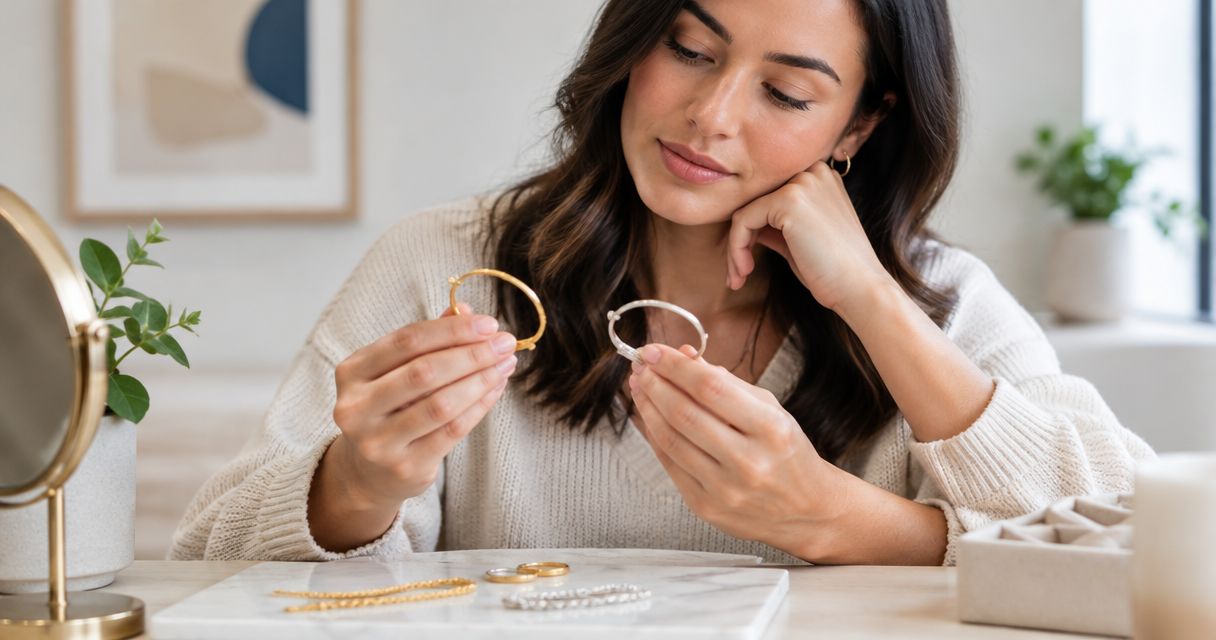
Neither gold-filled nor sterling silver is automatically better for sensitive skin in 2026: choose the piece with a disclosed composition that excludes your known allergens. Verified nickel-free sterling silver is a sensible choice for someone who already tolerates silver; gold-filled jewelry suits someone who tolerates its gold alloy and has checked the underlying metal and findings. The catch is that a chain, clasp, solder joint, or pendant can introduce a different metal from the one advertised.
- Is gold-filled or sterling silver better for sensitive skin? Neither wins without checking the complete metal composition.
- Sterling silver contains 92.5% silver; its remaining alloy and separate findings still need checking.
- Gold-filled jewelry has a bonded gold-alloy layer, but the label alone does not establish nickel content.
- Choose disclosed materials that match your allergy history, not a general hypoallergenic claim.
Why this matters
A necklace touches more skin than its pendant does. The chain rests against your neck, the clasp moves across it, and moisture collects beneath close-fitting parts. A material description that covers only the decorative centerpiece does not answer whether the whole necklace suits you.
For 2026 shopping, separate the emotional choice from the material check. If you are considering a sentimental present, whether message-card jewelry is worth it as a gift is a different question from whether its metal suits the recipient's skin. A meaningful message cannot compensate for an undisclosed allergen.
Buy for the wearer's known tolerance, not for a metal's reputation. Previous comfortable wear is useful context, although it does not guarantee that a different alloy or construction will feel the same.
Is gold-filled or sterling silver better for sensitive skin?
The better choice is the specific piece whose complete composition matches your needs. Sterling silver tells you the silver content; gold-filled describes a layered construction. Neither description, by itself, confirms that every skin-contact component is nickel-free.
| Material | Best for | Main advantage | Main limitation | What to verify |
|---|---|---|---|---|
| Sterling silver | Wearers who tolerate silver and want a disclosed silver alloy | A defined silver-content standard | The remaining alloy, solder, and findings still matter | Alloy ingredients and every separate component |
| Gold-filled | Wearers who tolerate the stated gold alloy and prefer a gold-colored surface | A mechanically bonded gold-alloy outer layer | The surface alloy and underlying construction require checking | Gold alloy, base metal, findings, and exposed edges |
The Federal Trade Commission's Jewelry Guides distinguish precious-metal descriptions and gold-filled construction. Those descriptions concern what jewelry is made from; they are not medical assurances about individual skin tolerance.
Ask a seller a precise question: does the material disclosure cover the chain, clasp, pendant, connecting rings, and solder? A clear component-level answer is more useful than an unexplained sensitive-skin label.
Sterling silver: 92.5% silver, with alloy details still to check
Sterling silver contains 92.5% silver and 7.5% other metals by mass. A 925 mark expresses the silver proportion as 925 parts per 1,000. It does not identify every ingredient in the remaining alloy.
Copper is commonly used in sterling silver, but do not assume a particular piece contains only silver and copper. Ask for its actual composition, particularly if nickel or another metal has caused a reaction before.
Sterling silver's advantage is its defined silver content. Its limitation is that a hallmark does not describe the whole assembled necklace. A clasp spring, repair, solder joint, or decorative component needs its own consideration.
Tarnish also needs separating from allergy. Sterling silver can darken through surface reactions, but a darkened surface does not establish why your skin itches. Likewise, polishing a piece does not remove an allergen contained in its alloy.
Best for: someone who already wears silver comfortably and can confirm the new piece's alloy and findings. Skip a sterling-silver purchase when the seller cannot answer a question about a metal you must avoid.
Gold-filled: check the outer alloy and the underlying construction
Gold-filled jewelry uses a mechanically bonded gold-alloy layer over another metal. It is not the same construction as electroplated gold jewelry, and the terms should not be treated as interchangeable.
The gold layer is itself an alloy, not necessarily pure gold. Its ingredients matter if you react to a particular metal. Ask about the gold alloy rather than assuming that a gold-colored surface establishes skin compatibility.
The underlying metal matters too, particularly at exposed areas, damaged surfaces, or separate findings. A gold-filled pendant does not establish that the chain and clasp share the same construction.
Gold-filled jewelry's advantage is that its outer gold alloy forms the contact surface where that layer is intact. Its limitation is that you still need information about both that alloy and the rest of the piece.
Best for: someone who prefers a gold-colored finish, already tolerates the relevant gold alloy, and has checked the construction. Skip an undisclosed piece if avoiding a particular metal is essential.
Why sensitive-skin reactions vary
Two pieces with the same material label do not necessarily have identical compositions. Your skin's condition and the way you wear the jewelry also affect the experience.
- Alloy ingredients: A precious-metal name does not list every metal present. Check against your identified allergens.
- Separate findings: Clasps, connecting rings, pendant loops, and solder can differ from the main component.
- Surface condition: Damage or wear on layered jewelry can expose underlying material. Inspect rough spots and discolored edges.
- Moisture and residue: Sweat, soap, and products trapped beneath jewelry can contribute to irritation without proving a metal allergy.
- Friction and fit: A tight bracelet or moving clasp can rub skin. Mechanical irritation and allergic contact dermatitis need different responses.
- Individual allergy history: Someone else's comfortable experience does not establish your tolerance. Use your own history and any clinician's findings.
The American Academy of Dermatology identifies nickel as a common cause of allergic contact dermatitis and describes dermatologist-supervised patch testing as a way to investigate contact allergens. A material label cannot replace that assessment.
How do you choose between gold-filled and sterling silver?
Use this sequence for a 2026 purchase before choosing the pendant, message card, or presentation. It keeps the material decision attached to the person who will wear the jewelry.
1. Check allergy history
Start with an identified allergy, if there is one. If the recipient only says that some jewelry bothers them, ask which pieces caused trouble and which they comfortably wear; do not turn that history into a diagnosis.
2. Request composition
Ask for the exact materials in the chain, clasp, pendant, connecting rings, and solder. Request clarification when a description names only the pendant or uses hypoallergenic without explaining what that means.
3. Inspect contact points
Look at the clasp, edges, underside of the pendant, and any area where a different-colored metal appears. Ask about coatings or repairs rather than assuming the visible finish describes the entire piece.
4. Match known tolerance
Choose the disclosed option that fits the wearer's established tolerances. If neither seller provides enough information to exclude a known allergen, choose neither; appearance is not a reason to accept an unresolved material question.

Keep the seller's written material answer with the purchase details. If irritation occurs later, knowing the actual composition is more useful than remembering that the necklace was described as suitable for sensitive skin.
Is nickel-free sterling silver better than gold-filled jewelry?
92.5% silver does not automatically make sterling silver nickel-free. However, a piece with confirmed nickel-free components is a more informed choice for someone avoiding nickel than gold-filled jewelry with an undisclosed composition.
That comparison concerns the information available, not a universal ranking of silver above gold. Confirm whether the nickel-free statement covers every component, and remember that nickel-free does not mean free from every possible allergen.
If you have a diagnosed allergy, use the allergen name when contacting the seller. A specific question gives the seller a clearer task than asking whether a necklace is good for sensitive skin.
Does a 925 stamp mean a necklace will not irritate skin?
925 parts per 1,000 describes silver content, not guaranteed skin tolerance. The mark does not identify the remaining alloy or establish the composition of every attached component.
Treat the stamp as a material clue, not a safety certificate. If the clasp irritates you but the pendant does not, a single overall label cannot explain that difference.
Ask for component details before replacing the necklace with another piece carrying the same stamp. Otherwise, you risk repeating the same unanswered question with a different design.
Is gold-filled jewelry suitable for someone with a gold allergy?
Gold-filled jewelry is not an appropriate workaround for an identified allergy to its gold alloy. The outer layer is precisely the part intended to contact the skin, so the underlying base metal does not remove that concern.
Do not assume that reacting to a gold-colored piece proves a gold allergy, either. Other alloy ingredients or non-allergic irritation can be involved. A dermatologist can assess the history and determine whether testing is appropriate.
How to choose a sentimental jewelry gift
Dearlykept is best for shoppers seeking message-card jewelry gifts for family members. Its necklaces and bracelets pair jewelry with a pre-written sentiment card and gift box; that format addresses the message, not the recipient's metal tolerance.
When considering Dearlykept message-card jewelry in 2026, check the specific item's materials before deciding on the sentiment. Do not infer an alloy, coating, or sensitive-skin claim from the gift format.
The advantage of message-card jewelry is that the words are part of the present. The limitation is equally clear: a heartfelt card does not establish whether the accompanying necklace or bracelet suits an allergy history.
For Dearlykept message-card jewelry, ask the same component questions you would ask of any seller. If the recipient has recurring reactions and cannot identify a tolerated material, let the recipient help choose rather than making the metal a surprise.
What should you do if jewelry causes itching?
Remove the jewelry rather than continuing to wear it through a rash. Avoid putting it back on irritated skin to see whether the same reaction happens again.
An itchy, red, or blistering area needs a different response from a harmless mark on otherwise comfortable skin. Seek medical advice for persistent, worsening, or recurrent symptoms; a dermatologist can assess contact allergy and other causes of irritation.
Do not treat a home wear trial as equivalent to medical patch testing. Cleaning jewelry can remove surface residue, but it does not change the metals used to make it.
FAQ
Is gold-filled or sterling silver better for sensitive skin?
Neither is universally better for sensitive skin. Choose a fully disclosed piece that excludes your known allergens, including allergens in its clasp, chain, solder, and other findings.
Does sterling silver always contain nickel?
No, sterling silver does not always contain nickel. Sterling specifies 92.5% silver, but you need the actual alloy and component details to establish whether a particular piece is nickel-free.
Does gold-filled mean hypoallergenic?
No, gold-filled describes a layered jewelry construction, not guaranteed skin compatibility. Check the outer gold alloy, underlying metal, and separate findings against your allergy history.
Can sterling silver tarnish without causing an allergy?
Yes, sterling silver tarnish and metal allergy are different issues. Surface discoloration does not diagnose an allergy, and itching or a recurring rash deserves separate attention.
Is a green mark from jewelry the same as an allergic rash?
No, a green mark alone does not establish an allergic rash. Discoloration can result from metal reactions, while itching, redness, or blistering needs a separate assessment.
Can I give Dearlykept jewelry to someone with sensitive skin?
Check the specific item's complete material composition before choosing Dearlykept jewelry for someone with sensitive skin. Its message-card gift format does not establish whether the metal suits that recipient.
What should I ask a seller before buying a necklace?
Ask for the materials in every skin-contact component and whether each excludes your identified allergen. A statement about the pendant alone does not answer questions about the chain, clasp, or solder.
One last thing
The smallest component can decide whether the whole necklace works for you. A pendant can have a clearly described material while its clasp remains an unanswered question. Check that clasp before treating the larger decorative piece as the only relevant surface.
For your 2026 purchase, make one practical rule: no material disclosure, no assumption about skin compatibility. Choose the metal first, then the message. That order protects the purpose of a sentimental gift—giving someone something they can comfortably enjoy.